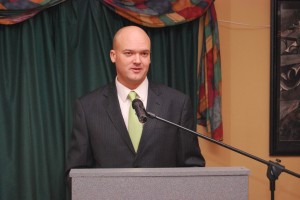
A tongue in cheek look at some of the changes in the Toastmasters organisation over the last few years.

You have been a member for more than a few years if:

  1. You achieved a CTM award. Do you remember the Able Toastmaster award?
  2. Your CTM manual had 15 speeches in it
  3. As VP Education, you had to fax programmes to members, and if you were a member the programme was faxed to you by the VPE
  4. You remember carbon-copied area visit reports which needed to be mailed to the district governor
  5. Club and district performance reports were mailed to clubs and district on a quarterly basis. You could not view them online
  6. Membership application forms needed to be mailed or faxed to WHQ
  7. Educational awards needed to be mailed or faxed to WHQ
  8. You were not admitted to a club meeting unless you were wearing a jacket and tie (ok some clubs still enforce this, but very few)
  9. New membership dues was $16, and renewals $18 (or even less)

While this list is in jest, it shows how the organisation has progressed over the last several years, and how it continues to be a dynamic and growing organisation. Now we have:

  1. A very strong communication and leadership track
  2. Programmes are placed on club websites and emailed to members
  3. Area visit reports are electronically processed and automatically emailed to relevant people
  4. All club and district reports (as well as archives) are available online
  5. Most forms can now be processed online, including new membership applications, dues payment and  educational awards
  6. It is far less formal than in the past, and clubs have adapted their formality to suit their markets
  7. We now have a podcast, and online training
  8. Yes dues are now $20 and $27 respectively, but still astonishingly good value

What should be added to the list?

, , ,

Hi all

Just a quick note to let you know that I recently contributed to an article for Destiny Man Magazine.The article is about common mistakes we make when speaking in public, and on how to avoid them. You can read the article online here.

Craig

, , , , ,

Do you want free publicity? Then use these tips.

  1. Website –crucial; keep it simple. Free!
  2. Community adverts in newspapers; consistent. Call the editor and ask him for lead times; make friends!
  3. Facebook page
  4. Community papers – tell them success stories
  5. Advertise at venue (do they have a newsletter); leave back issues of the magazine at the venue (with contact details)?
  6. Members – advertise at businesses
  7. Speak to district and see what they can give you.
  8. Download free flyers from the Toastmasters International website
  9. Guest list; add everyone who contacts you to the guest email list (ask them if you can add them to the list)
  10. Follow up immediately to guests that have attended and that contact you
  11. Ensure club details are correct with WHQ!
, ,

You often hear me speaking about the value of impromptu speaking, and why learning to speak off the cuff is as important as learning to speak prepared.

Here is a great resource; an entire website dedicated to the art of “table topics”, or speaking impromptu.What I like about the site is  that he gives you a lot of templates, or outlines you can use for practising unprepared topics.

Here is an example:

Split Personality

Number of participants: Two

The majority of the information we convey doesn’t come from what we say, but from how we say it. Bodily gestures are a large part of this. The goal of this template is to separate these different aspects of communication between two people. One participant does the talking, the other does the gesturing.

There are two ways to use this template. Either one participant talks, and the other creates the corresponding gestures, or one uses gestures, and the other talks about what the gestures are indicating.

Doing this effectively requires a reasonable amount of cooperation from the participants. It can weaken the delivery if both participants end up gesturing (once you do it, it can be a difficult thing to put down temporarily!). This should possibly be made clear to the participants.

It’s interesting to see the different ways people can take this, sometimes you may have one participant controlling the flow of the entire topic, while others will work together to figure out how the talk or story will evolve.

The purpose of this template is to give people the chance to carefully consider what their gestures are saying to an audience.

Thanks to Andrew William’s for creating the resource.

, , ,
Gary Bailey

Gary Bailey

Some tips I picked up from Gary (ex goal keeper for Manchester United) at our Toastmasters conference. Enjoy!

Manchester United:

  • Is a $1 billion business
  • Has 300 million customers
  • Delivers weekly to its customers

The principles of a good soccer team apply to business as well…

  • Be tough- learns to takes knocks
  • Build on gratitude
  • Appreciate staff and all those around you
  • Things go wrong for everybody at some time
  • It’s how you deal with life, not what happens to you that is important
  • Plan for the future
  • Don’t send emotional emails because there is no emotion in email
  • Make time for others
  • Raise your energy
    • Body; food & exercise
    • Spirit; helping others
    • Mind;
    • Emotions;
, , , , ,

I have received a copy of my recent interview with the times. This was recorded at the dinner at the Toastmasters conference in Johannesburg.  I discussed Toastmasters, the importance of communication and leadership skills, and why the Toastmasters programme is so important.


Download the podcast.

Thanks to Ian and Michael Bratt, as well as the Times for the copy.

, , , ,

Listen on Times Live to Michael Bratt interviewing myself, as well as Keynote speaker Gary Bailey and C&L award winner Bassie Kumalo.

I was interviewed at the Toastmasters conference recently held at Gold Reef City. I spoke about the value of communication, leadership, and the Toastmasters programmes.

, ,

Much to my surprise, at a Toastmasters meeting on Wednesday, I got the award for best evaluator. That means that I gave the most constructive feedback to a speaker at the meeting :-)

, ,

Here is a workshop that may interest you. It is being run by two very good friends of mine, and it promises to be a first-class event.

Find the Storyteller inside

Telling stories as a lure to the future is an ancient strategy of sages, philosophers and great religious leaders. – Diarmuid O’Murchu

This workshop will show you how to ritualise and energize your life though engaging with stories – those of your own and of others. Climb inside stories and tell them from the inside. Listen to them, Shape them. Taste them on your tongue. Reconnect to creativity, memory and imagination. This workshop experience will energize you. You will get a clearer understanding of how we construct our lives as fiction and how this can release us into a more abundant life. You’ll emerge with stories in your heart and on your lips.

Storyshop Programme

Week 1: The Why of Stories

The power of storytelling to send us travelling and bring us home.

Week 2: Archetypal Stories

Myths and Fairy tales – the story underneath the story.

Shapes, patterns and rituals. Engaging symbols.

Week 3: Sourcing Stories through observation

Listen with the ear in your chest. (Rumi)

Inner and outer looking. Our looking ripens things. (Rilke)

Week 4: Structure your own Stories

Story stones to step on: the symmetry of a tale. Beginnings and endings.

Week 5: Practical: telling Stories

How to tell a story: how to breathe, climb inside it; ‘if you can’t see it, you can’t tell it’.

Make up stories, finding your voice, your silences.

Fabric and fabrication.

Week 6: The Circle and the Fire – A celebration of Story telling

Participants tell and receive stories.

The Joy and Call of Stories Will:

  • explain the power of storytelling
  • give you an understanding of how stories work
  • give you practical tools to work with in the telling of stories
  • help you develop the ability to tell a good story
  • ignite your creativity and imagination

Facilitators

Dorian Haarhoff is a storyteller, writer, mentor and a former Professor of Literature. He is passionate about developing innate creativity and imagination. He believes that stories can heal, build communities and create new worlds.

Kirsten Pearson is a Dialogue facilitator, published poet and the volunteer Project Lead for the Movement for Sharing Life Stories. She promotes story telling as a way to support change, create new realities and transform the potential of our future.

Who will benefit from attending:

Writers, storytellers, readers, travelers, lovers of words, images, silences…therapists, artists, spiritual seekers, coaches, teachers, magicians, tricksters, ecologists…anyone who wants to raise their story IQ.

Dates

  • Saturday, 26 September 09: 14:00 – 17:00
  • Saturday, 03 October 09: 14:00 – 17:00
  • Saturday, 10 October 09: 14:00 – 17:00
  • Saturday, 17 October 09: 14:00 – 17:00
  • Saturday, 24 October 09: 14:00 – 17:00
  • Saturday, 31 October: 14:00 – 17:00

Venue

Novalis Ubuntu Institute – 39 Rosmead Avenue, Wynberg (a white domed building between Wetton and Ottery Road)

Cost

R900.00 (or R150 per week)

Should you wish to pay in instalments of R150 per week, that option is available.

To register

To book, contact Kirsten Pearson on 021 461 3145 or email: kirstenpea@gmail.com

, ,

Hi All

The recent Toastmasters Induction Dinner has made it into the Cape Town local papers. Cape Community Newspapers ran an article which was syndicated to most of the local community newspapers.

Correction: I am the second youngest District Governor. Howard Steinberg beat me in 1980.

You can read the article below.

Craig Induction Dinner

I hope that it brings some new members in.

, ,